Introduction
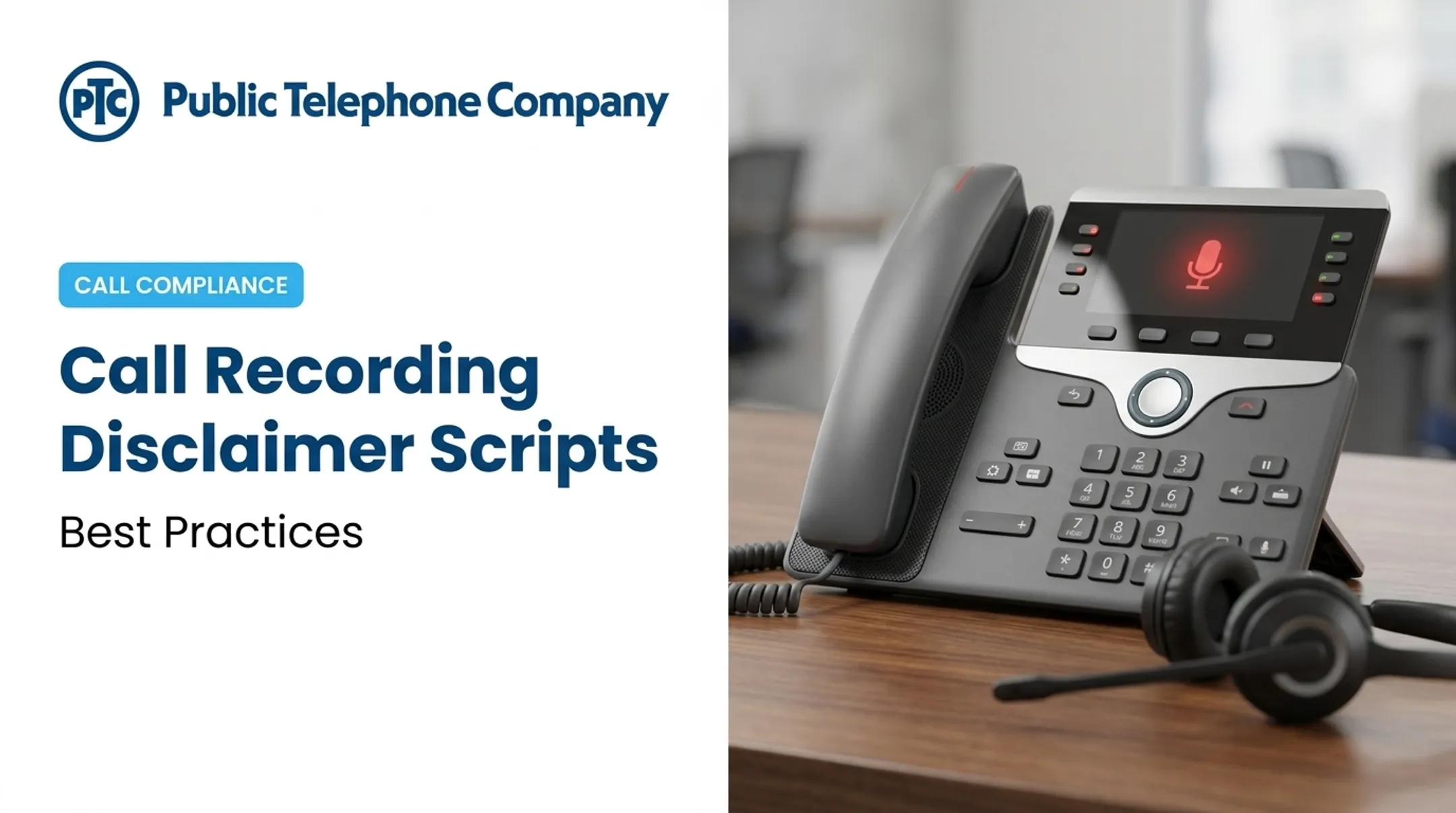
Recording customer calls has real upside. It supports quality assurance, sharpens staff training, creates accurate notes, and helps resolve disputes when a customer's memory of a conversation differs from an agent's.
But every recording also creates compliance risk. Did each person on the call know it was happening, and did they need to agree first?
The answer depends on where your callers and employees are located, what federal and state laws require in that combination, and how clearly your business discloses the recording before the conversation gets substantive.
This guide walks through the U.S. consent framework, disclosure language that holds up, and the process businesses use to stay consistent across teams and locations.
A quick disclaimer: this article is general educational information, not legal advice. Recording laws vary by state, change over time, and depend on your specific facts. Confirm current federal, state, and industry-specific requirements with qualified counsel before finalizing your policy.
Key Takeaways
- U.S. rules split into one-party and all-party consent; interstate calls can trigger both.
- Disclose recording—and any later transcription or analysis—before the conversation starts.
- Back written policy with training, system controls, refusal procedures, and secure storage.
- Audit recordings, consent records, and system settings on a schedule—not as a one-time setup.
What U.S. Call Recording Compliance Requires
Disclosure, Consent, and Notification Aren't the Same Thing
Three terms get mixed up in call recording compliance:
- Disclosure — telling someone a call may be recorded
- Consent — their agreement, by silence, continued participation, or an affirmative "yes"
- Notification — the mechanism that delivers the disclosure (spoken line, tone, or IVR message)
What happens after the recording exists is separate: transcription, speech analytics, AI scoring, storage, sharing, and playback. A disclosure that only mentions "recording" may not cover transcription or AI analysis, and several state frameworks treat that gap seriously.
One-Party vs. All-Party Consent
Federal law sets the floor. Under 18 U.S.C. § 2511, intentionally intercepting a wire or oral communication is prohibited, but there's an exception when the recorder is a party to the call or one participant has given prior consent. That's one-party consent, and most states follow it.
A smaller group of states require all-party consent: every person on the call must be informed and, depending on the state, must agree before recording starts.
According to Justia's 50-state survey (reviewed September 2024), states that clearly or potentially require all-party consent in some cases include California, Florida, Illinois, Maryland, Massachusetts, Michigan, Pennsylvania, and Washington, among others.
A few states complicate this further. Oregon generally requires one-party consent for phone calls but all-party consent for in-person conversations. Michigan has conflicting case law. Nevada treats oral and telephonic communications differently. Don't rely on a generic state list—verify current statutory language for your situation.

Interstate Calls Add Another Layer
Say your call center sits in a one-party state, but your customer is calling from an all-party state. Which rule wins?
In Kearney v. Salomon Smith Barney, the California Supreme Court held that California's all-party consent rule applied to an out-of-state company that secretly recorded calls with California residents, even though the company's home state followed one-party consent.
The holding was limited to undisclosed recording of California residents while they were physically in California. The practical lesson still generalizes:
- When participants are in different states, the stricter jurisdiction's rule may govern.
- Multi-state businesses often default to all-party disclosure instead of tracking rules call by call.
Situations That Need Extra Care
A few scenarios raise the stakes:
- Conference calls and transfers — new participants joining mid-call need their own disclosure.
- Supervisor monitoring and call barging — silent monitoring can trigger the same consent rules as recording.
- Healthcare calls — HIPAA's Security Rule applies when PHI moves through your phone system; plan for risk analysis, encryption, and authentication.
- Payment card calls — PCI DSS requires securing any cardholder data in a recording; pause-and-resume keeps payment details off the recording entirely.
For any of these, confirm requirements with counsel and your compliance team before assuming a general disclosure covers you.
When and How to Make a Recording Disclosure
Disclose Before the Conversation Gets Substantive
The safest operational default is to disclose at the very start of the call—before recording, transcription, or meaningful discussion begins.
California Attorney General materials from the Wells Fargo settlement describe the same principle: each party to a confidential conversation must be advised at the outset so they can object or end the call.
Waiting until after a customer has shared account details or personal information defeats the point of disclosure. Have counsel confirm exact timing rules for your jurisdictions; earlier is always safer.
Inbound vs. Outbound Workflows Differ
- Inbound calls: Use an automated IVR message or recorded greeting to deliver notice before the call connects to a live agent.
- Outbound calls: Have the agent or dialer deliver notice as the call opens—before pitching, asking questions, or collecting information.
Choosing a Notice Method
| Method | Best For | Watch For |
|---|---|---|
| Live verbal notice | Personalized sales or service calls | Needs consistent agent training |
| Prerecorded/IVR message | High-volume inbound queues | Callers may skip or mute it |
| Written/on-screen notice | Web calling or chat-to-call | Misses phone-only callers |
| Audible tone | Ongoing recording indication | Meaning may not be obvious |
No nationwide safe harbor makes any one method legally sufficient everywhere. Washington's statute, for example, allows an announcement "in any reasonably effective manner," but the announcement itself must be recorded if the call is recorded.
Verify your method against the applicable state statute. Do not assume a generic "calls may be recorded" line covers every scenario.
What the Disclosure Should Actually Say
A useful disclosure covers four points:
- Recording will occur, is occurring, or may occur
- Whether transcription or analysis follows, including any AI-based tools
- A general purpose such as quality, training, or service improvement
- What the caller can do if they prefer not to be recorded, when policy allows an alternative
Quick Compliance Checklist
- Notice delivered before substantive conversation starts
- Acknowledgment obtained where the applicable state requires it
- Recording starts only after proper notice
- New participants on transfers or conferences get their own disclosure
- Documentation retained showing the process was followed
Call Recording Disclosure Scripts and Objection Handling
Sample Scripts (Adapt for Your Jurisdiction)
Inbound call:
"This call may be recorded and may be transcribed for quality and training purposes. By continuing, you agree to this recording."
Outbound sales or service call:
"Before we get started, I want to let you know this call may be recorded and transcribed to help us serve you better. Is that okay with you?"
Explicit-consent request (all-party states):
"This call will be recorded for [purpose]. Do I have your permission to record?"
Treat these as drafts only. Have counsel review final wording for every state where your callers or agents are located.
Handling Refusals and Objections
When a caller pushes back, agents need a clear script:
- "Why is this call recorded?" State the purpose in plain terms: quality, training, or dispute resolution.
- "Stop the recording." Stop immediately. Once consent is revoked, recording must end.
- "I don't want to be recorded." Follow your opt-out workflow: offer a non-recorded path if policy allows, or escalate to a supervisor.

Skip vague, technical, or joking language that downplays the recording. A line like "this call might get recorded, no biggie" creates liability instead of consent.
Once scripts are locked, validate them before agents go live.
Test Before You Deploy
Run scripts through:
- Clarity — Would a first-time caller understand it on the first pass?
- Accessibility — Does it work for relay services and non-English speakers?
- Legal sign-off — Has counsel confirmed it covers your operating states?
How to Build a Call Recording Disclosure Process
Start With a Written Policy
Document, in plain language:
- Which call types and teams are recorded
- How consent is obtained (and where all-party rules apply)
- How refusals get handled
- Who owns policy updates as laws change
Use Your Phone System's Controls
A cloud-hosted business phone system can put the policy into practice—if you configure it correctly. Look for:
- Consistent, system-delivered notices across inbound and outbound flows
- Recording permissions tied to specific call types or extensions
- Pause/resume controls for sensitive moments like payment collection
- Exception lists for calls that shouldn't be recorded
- Administrative oversight and reporting
Public Telephone Company's cloud-hosted VoIP and PBX platform includes call-flow configuration and reporting that teams use to wire these controls into everyday operations. Multi-location businesses can apply different recording rules by state or team when disclosure requirements differ.
No phone system alone guarantees legal compliance. The platform supports your policy; the policy still has to be legally sound.
Train Employees on More Than the Script
Training should cover:
- The approved disclosure script and exact timing
- What to do differently for conference calls, transfers, and supervisor monitoring
- How to handle sensitive information (payment, health, financial details)
- Refusal handling and escalation paths
Govern the Recordings You Keep
Once recordings exist, protect them:
- Limit access by role, not by default company-wide visibility
- Set retention and deletion schedules — note that FINRA Rule 3170 requires certain firms to retain recordings for at least three years, while HIPAA itself doesn't set a specific retention period for call recordings
- Encrypt files in transit and at rest
- Document permitted uses and control export or sharing
Audit Regularly
On a recurring schedule, review:
- Call samples and staff adherence to the disclosure script
- System settings, consent logs, and exception lists
- Retention and breach-notification rules for your industry and states
These obligations change more often than most businesses expect. A durable process pairs a written policy with system controls, trained staff, governed recordings, and regular audits.

Frequently Asked Questions
Do I have to disclose that I am recording a phone call?
Requirements vary by federal and state law. Some states require consent from every participant, not just the recorder. When you're uncertain which rule applies, disclose clearly and obtain consent before recording.
What is a good script for a call recording disclosure?
Start with a clear notice that the call may be recorded, why you record, and whether transcription follows. Have counsel review the final wording for every jurisdiction your callers are in.
Can you tell if someone records your call?
Not always. Notices, tones, and system prompts vary by business and jurisdiction. The absence of an audible signal doesn't tell you whether recording is happening or whether it's lawful.
What should a call recording disclosure include?
State that recording (and transcription, if applicable) is happening, explain the general purpose, and deliver the notice before substantive discussion. Note any opt-out option your policy offers.
What should a business do if someone refuses to be recorded?
Follow your documented opt-out workflow. Stop or pause recording when required, offer an alternative if one exists, and escalate uncertain cases to a supervisor.